

When products do not pass cleanly through an X-ray inspection system, the curtain may not be the first thing production or engineering teams look at.
Conveyor speed, product spacing, packaging and machine settings are obvious areas to check. But the way the product interacts with the X-ray shielding curtains at the entrance and exit of the tunnel can also affect how smoothly it travels through the system.
This can be particularly noticeable with lightweight, unstable or easily disturbed products.
Can X-ray curtains affect product flow?
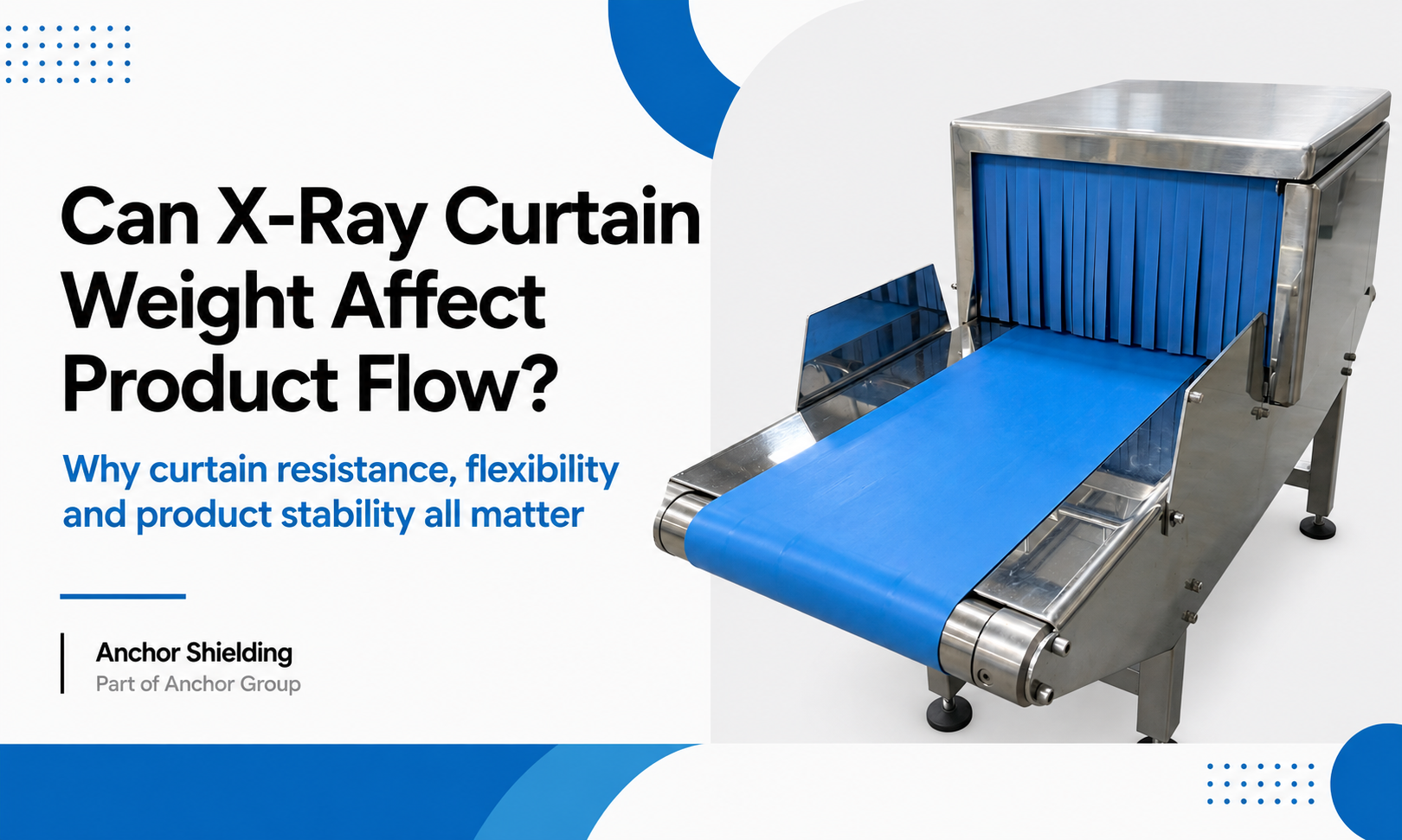
Yes. X-ray shielding curtains physically contact products as they enter and leave many inspection systems.
Depending on the product and curtain arrangement, that contact can affect how smoothly a pack passes through the tunnel.
Potential signs of a problem can include:
- lightweight packs being pushed or dragged
- products tipping or changing orientation
- packs bunching together at the curtain
- intermittent jams or hold-ups
- the curtain lifting unevenly as products pass
- disruption becoming more noticeable at higher line speeds
This does not automatically mean that the curtain is too heavy or that it needs replacing.
However, if problems repeatedly occur at the point where the product meets the curtain, the curtain arrangement is worth including in the investigation.
Why are lightweight products more sensitive?
A heavy carton or rigid product may have enough momentum and stability to move through the curtain with little noticeable disruption.
A lightweight pouch, small flow-wrapped item, tray or other less stable product can behave differently.
The force needed to move the curtain out of the way becomes more significant relative to the weight and stability of the product itself.
This is why X-ray inspection equipment designed for lightweight products often places particular emphasis on allowing products to pass freely through the inspection area.
The problem is not limited to weight alone either. Product height, shape, centre of gravity, packaging material and spacing can all influence how it interacts with the curtain.
Does a lighter X-ray curtain automatically solve the problem?
Not necessarily.
The shielding curtains form part of the radiation protection arrangement of the X-ray system. Any replacement still needs to meet the required shielding specification for that particular machine.
Curtain thickness, material, lead equivalence, strip width, overlap, tunnel configuration and tube voltage can all be relevant.
That means reducing curtain resistance cannot come at the expense of the machine's required shielding performance.
The aim is therefore not simply to fit the lightest possible material. It is to find an appropriate curtain arrangement that provides the required shielding while also behaving correctly with the products travelling through the system.
Curtain flexibility matters too
Weight is only part of the picture.
Two curtains can interact differently with the same product depending on their flexibility, surface characteristics, thickness, condition and construction.
A curtain that has become stiff or distorted may require more effort for a lightweight product to move through it. Damaged or poorly hanging strips can also behave inconsistently as packs pass underneath.
The curtain should lift as required when the product enters the tunnel and return correctly afterwards.
If it does not, the issue may relate to the condition of the existing curtain rather than simply its original specification.
Could the curtain be causing throughput problems?
If a production line is experiencing repeated disruption around an X-ray inspection system, it can be useful to watch exactly what happens as products enter and exit the tunnel.
Questions worth asking include:
- Do products slow down when they reach the curtain?
- Are lightweight packs being knocked out of position?
- Do products occasionally tip, twist or catch?
- Are packs beginning to bunch together before or inside the tunnel?
- Does one curtain row behave differently from another?
- Are the strips returning freely after each product passes?
- Has the curtain become noticeably stiff, curled or damaged?
- Does the problem affect certain products more than others?
If several different products run through the same machine, comparing their behaviour can be especially useful.
A heavier or more stable pack may pass without issue while a lighter format struggles with the same curtain arrangement.
Product flow should be considered when replacement curtains are specified
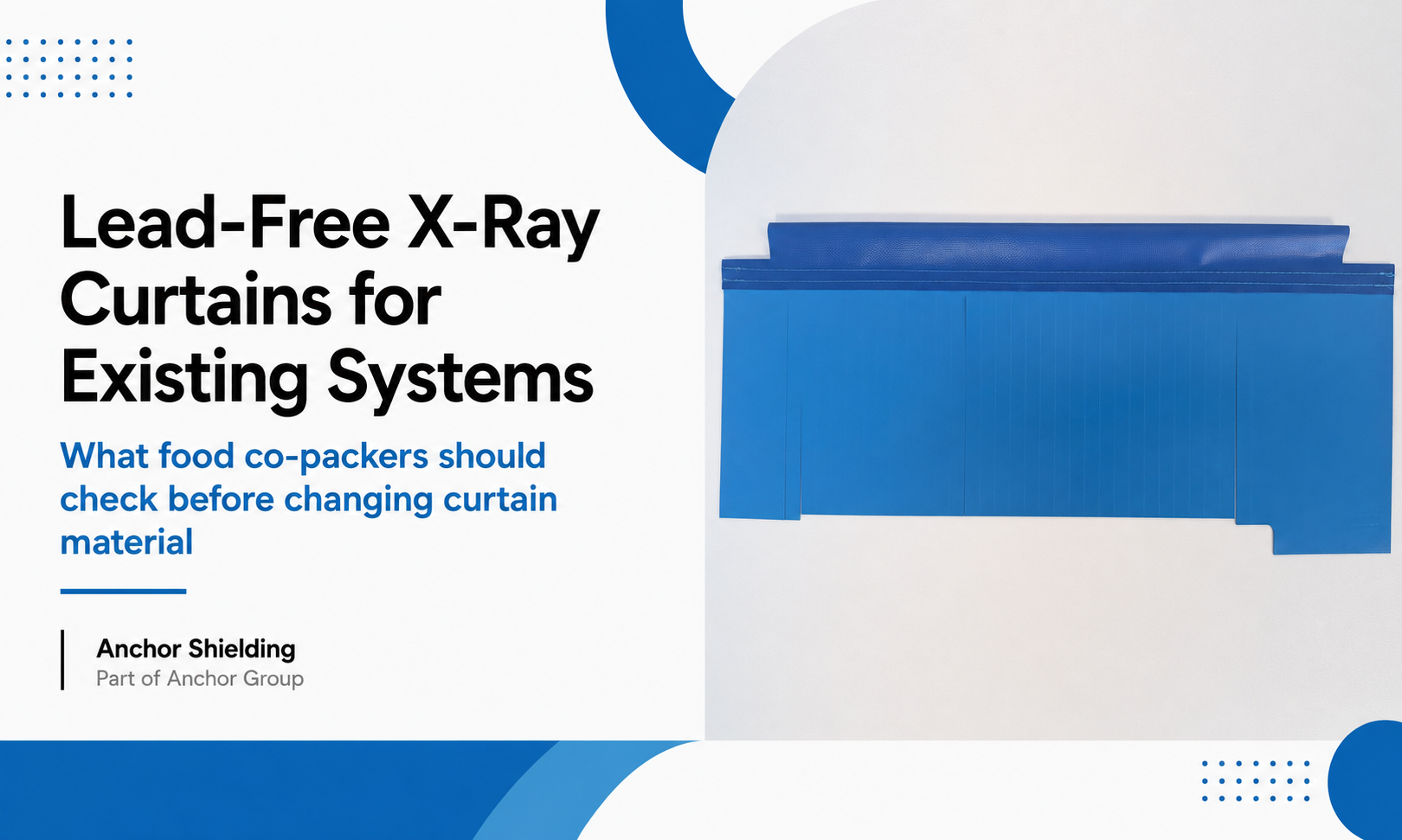
When replacing X-ray curtains, it is easy to focus entirely on dimensions.
Length, width and fixing-hole positions obviously matter, but they do not tell the whole story.
Useful information can also include:
- machine manufacturer and model
- required lead equivalence
- operating tube voltage
- existing material thickness
- curtain strip width and overlap
- number and position of curtain rows
- products travelling through the machine
- product weight and dimensions
- line speed
- any existing product-flow problems
- photographs, drawings or samples of the current curtains
Understanding the issue before manufacturing a replacement set gives the supplier a much clearer picture of what the curtain needs to do in practice.
What if the current curtains are disrupting production?
The first step should be to establish whether the curtain is genuinely contributing to the problem.
Where possible, record what is happening at the entry and exit of the tunnel and note which products are affected.
Photographs, video, machine information and details of the existing curtain can then help when reviewing the current arrangement.
The existing shielding specification should also be confirmed rather than estimated from the curtain dimensions alone.
A replacement curtain can then be considered against both requirements: the shielding performance required by the machine and the way products need to move through it.
Lead-free replacement X-ray curtains from Anchor Shielding
Anchor Shielding supplies supashield™ lead-free X-ray curtain material, strips, panels and complete replacement curtain sets for food inspection, baggage scanners and other X-ray scanning applications.
Our in-house conversion capability means curtains can be produced to agreed dimensions, fixing arrangements and customer drawings, with samples also available where required.
If products are being disturbed, dragged or struggling to pass cleanly through your existing X-ray curtains, send us the machine details, current curtain specification and any photographs or drawings available.
We can review the requirement and help establish an appropriate replacement route for the application.
Contact Anchor Shielding to discuss your X-ray curtain requirements.