

.png)
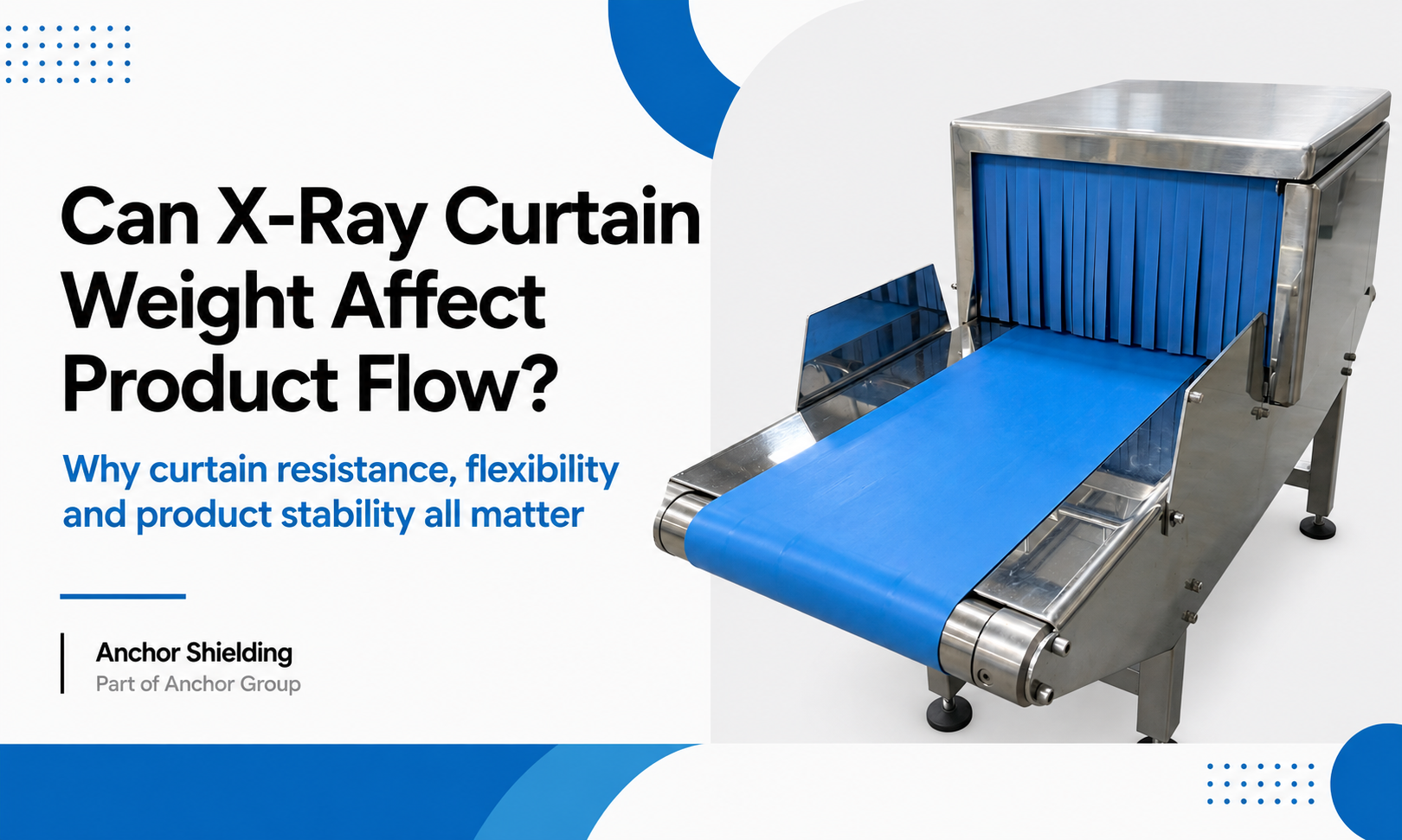
Food safe lead-free radiation curtains are used in X-ray inspection systems to help form part of the shielding arrangement around the machine opening while still allowing products to pass through the inspection tunnel.
For food manufacturers, OEMs, service teams and replacement-part buyers, these curtains are not just a consumable item. They can affect radiation shielding, product flow, hygiene expectations, machine uptime and day-to-day inspection performance.
What affects the performance of food safe lead-free radiation curtains?
The performance of food safe lead-free radiation curtains is affected by the shielding specification, lead equivalence, machine design, tunnel opening, curtain fit, strip overlap, product flow, flexibility, cleaning routine and wear over time.
A curtain may be made from the right material, but if it is cut incorrectly, fitted poorly, used with the wrong overlap, or placed in an application it was not specified for, it may not perform as expected in use.
That is why replacement X-ray curtains should be specified against the machine, product and application, not just ordered by size.
Why does the curtain need to suit the X-ray inspection system?
A food safe radiation curtain that works well in one X-ray inspection system may not be right for another.
Food X-ray inspection systems are used across a wide range of product types, including packaged, unpackaged, bulk, boxed, bagged and trayed goods. Each application places different demands on the curtain.
A replacement set should not be based on size alone. Useful information can include:
- machine make and model
- tunnel opening size
- current curtain dimensions
- existing lead equivalence or shielding specification
- tube voltage
- product size, shape and weight
- fixing method
- strip width and overlap
- food-contact or documentation requirements
If these details are missed, the curtain may fit physically but still not behave as expected once the line is running.
Why does lead equivalence matter for lead-free X-ray curtains?
Lead-free does not mean the shielding requirement disappears.
A lead-free radiation curtain still needs to meet the required shielding performance for the machine and application. In practice, that usually means confirming the required lead equivalence, or matching the existing approved specification for the system.
This is especially important when replacing curtains on existing food X-ray inspection equipment. A like-for-like size replacement is not always enough if the shielding requirement has not been checked.
Lead-free X-ray curtains can be a strong option where a business wants to reduce lead from food production, maintenance and waste-handling environments. But the material still has to be specified properly.
How do fit, overlap and coverage affect curtain performance?
Curtains inside X-ray inspection systems are not just flat sheets. They are part of the entry and exit arrangement around the tunnel.
The way the strips overlap, hang and return to position after product passes through can affect how consistently the opening is covered during operation.
If the strips are too narrow, too short, too stiff, too worn or not fitted correctly, the curtain may not perform as intended.
This is why drawings, photos, samples or the original curtain specification can be useful when arranging replacement X-ray curtains. The physical design matters as well as the material choice.
For production teams, the aim is straightforward: the curtain needs to support the required shielding arrangement without creating avoidable issues with product flow.
How does product flow affect food scanner curtains?
Food products do not all pass through an X-ray inspection system in the same way.
A lightweight wrapped product, a rigid tray, a bagged product and a larger carton can all interact with the curtain differently. Some products pass through easily. Others may drag, lift or disturb the strips more than expected.
That can affect:
- how smoothly products move through the machine
- whether packs are disturbed
- whether manual intervention is needed
- how quickly the curtain returns to position
- how much wear occurs over time
For high-throughput food production lines, these are not small details. A curtain that creates friction at the tunnel can quickly become a production issue.
That does not mean every application needs the same curtain design. It means the curtain needs to be considered in the context of the actual product, machine and production environment.
We have worked with customers who have come to us after experiencing exactly these kinds of problems, including products not passing cleanly through the curtain because the material was too rigid, or friction at the tunnel causing disruption to the line. In these cases, the answer was not simply to supply another standard curtain. It was to look at the machine, the product, the opening, the curtain design and the material behaviour together.
By supplying lead-free radiation curtains designed around the customer’s application, we have helped resolve product-flow issues and provide a curtain arrangement better suited to the way the machine is actually being used.
That does not mean every application needs the same curtain design. It means the curtain needs to be considered in the context of the actual product, machine and production environment.
Why do flexibility and working conditions matter?
Curtain flexibility can affect how the material performs in use.
In chilled or demanding production environments, the curtain needs to remain flexible enough to allow products to pass through the tunnel cleanly. If a curtain becomes too stiff, damaged or distorted, it can affect both movement through the machine and the way the strips return to position.
Anchor Shielding’s food safe lead-free radiation curtains are designed for demanding X-ray inspection environments. Our supashield™ material is lead-free, durable, resistant to wear and oil, and maintains flexibility at temperatures as low as -10°C.
That material information is useful when checking suitability, but it should still be considered alongside the machine details, product format and required shielding specification.
How do cleaning and maintenance affect service life?
In food production, X-ray inspection curtains are part of a working environment. They may be exposed to cleaning routines, product residue, oils, handling and repeated movement throughout the day.
Over time, teams should look for signs of wear such as:
- cracking
- splitting
- stiffening
- curling
- damaged fixing holes
- missing strips
- distortion
- poor return after product passes through
- visible gaps caused by wear or incorrect hanging
Regular checks can help identify replacement needs before the curtain affects production, service activity or audit confidence.
When should food scanner curtains be replaced?
Food scanner curtains should be reviewed when they show visible damage, become stiff or distorted, no longer hang correctly, create product flow issues, or no longer match the required machine specification.
Replacement is also worth reviewing when the product format, line speed, cleaning process or site preference around lead-containing materials has changed.
Many enquiries for food safe lead-free radiation curtains begin when a machine needs a replacement set. That is often the right moment to check whether the current curtain arrangement is still suitable.
A replacement does not need to become complicated, but the right checks early on can help avoid the wrong material, the wrong cut or a set that causes problems once installed.
Can lead-free X-ray curtains be custom cut?
Yes. Lead-free X-ray curtains can be cut and supplied to suit the machine, tunnel opening and existing fixing arrangement.
That may mean working from a drawing, a sample, a photo, or a current curtain specification. It may also mean confirming strip width, overlap, fixing hole positions, material thickness and the required lead equivalence before production.
This is where in-house conversion support can make the buying process easier. Rather than sourcing material and arranging cutting separately, customers can work with Anchor Shielding to supply lead-free radiation curtain material in the format required for the application.
What documentation may be needed for food safe radiation curtains?
Documentation can form part of the buying decision, especially for food inspection equipment.
Depending on the project, buyers may need information on food-contact suitability, RoHS status, material specification, lead equivalence or other supporting documents. The exact requirement will depend on the machine, customer, site standards and end-use application.
Rather than assuming every project needs the same paperwork, it is better to confirm the documentation required before ordering.
That helps avoid delays and makes sure the material supplied is aligned with the customer’s process, compliance expectations and internal sign-off.
What information helps when requesting a quote?
To quote accurately for food safe lead-free radiation curtains, it helps to provide as much application detail as possible.
The most useful information includes:
- machine make and model
- required lead equivalence
- existing curtain dimensions
- tunnel opening size
- fixing method
- strip width and overlap
- product type
- drawing, sample or photo of the current curtain set
- food-contact or documentation requirements
These details help ensure the replacement curtain is quoted against the right specification, rather than treated as a simple cut piece of material.
Why speak to Anchor Shielding?
At Anchor Shielding, we supply food safe lead-free radiation curtains for X-ray inspection systems, including replacement curtain sets and converted material for customer-specific requirements.
The point of this article is simple: performance in use depends on getting the details right before the curtain reaches the machine.
We can support customers with lead-free radiation curtain material, replacement sets, samples where required and in-house conversion to suit customer drawings or application requirements.
Whether you are replacing existing food scanner curtains, reviewing a current X-ray inspection set-up, or looking for a lead-free option for a new project, we can help work through the practical details that affect performance in real use.
To discuss food safe lead-free radiation curtains for your X-ray inspection system, contact Anchor Shielding.