

When luggage scanner curtains need replacing, the first question is often simple:
“What curtain material do we need?”
In practice, the answer depends on more than choosing lead-free shielding and cutting it to size.
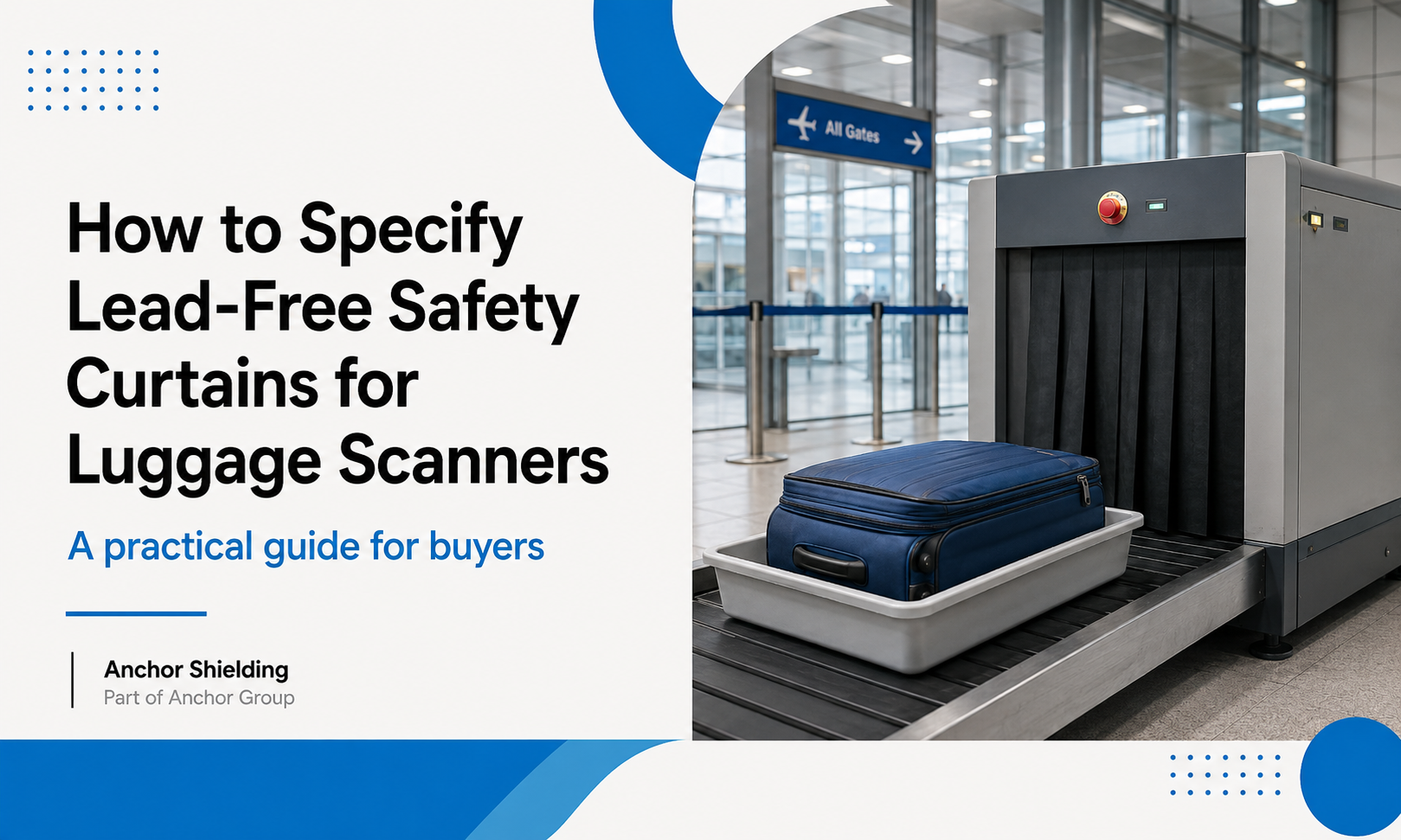
Luggage scanner curtains need to help contain X-rays at the tunnel entry and exit while still allowing bags, trays and parcels to pass through the system smoothly. If the curtain is the wrong size, too stiff, poorly matched to the scanner, or supplied in the wrong format, it can create practical problems once fitted.
That does not mean buyers need to know every technical detail before getting in touch.
But there are a few useful points that can help make the specification process much easier.
Start with the scanner, not just the curtain
The best place to start is the scanner itself.
For replacement curtain projects, useful information includes the scanner make and model, where the curtain sits on the machine, whether it is for the entry or exit tunnel, and whether the existing curtain is being copied or improved.
Photos can also help. In many cases, a clear image of the current curtain arrangement, fixing method and tunnel opening can give the supplier a better starting point than a written description alone.
If drawings are available, even better. But if not, the enquiry can still move forward.
At Anchor Shielding, we can support customers from drawings, existing curtain requirements, photos or custom designs, depending on what is available.
Confirm the shielding requirement
With any X-ray scanner curtain, shielding performance has to come first.
The curtain material needs to suit the scanner and the radiation shielding requirement for that machine. This may include the required lead equivalence, tube voltage or existing curtain specification.
If that information is already known, it should be shared at the start of the enquiry.
If it is not known, buyers should not assume. The original machine specification, OEM information, radiation protection adviser, previous supplier details or site survey records may all help confirm what is required.
This is an important point because lead-free does not mean “one material suits every scanner”. The curtain still needs to meet the shielding requirement for the specific application.
Check the curtain format
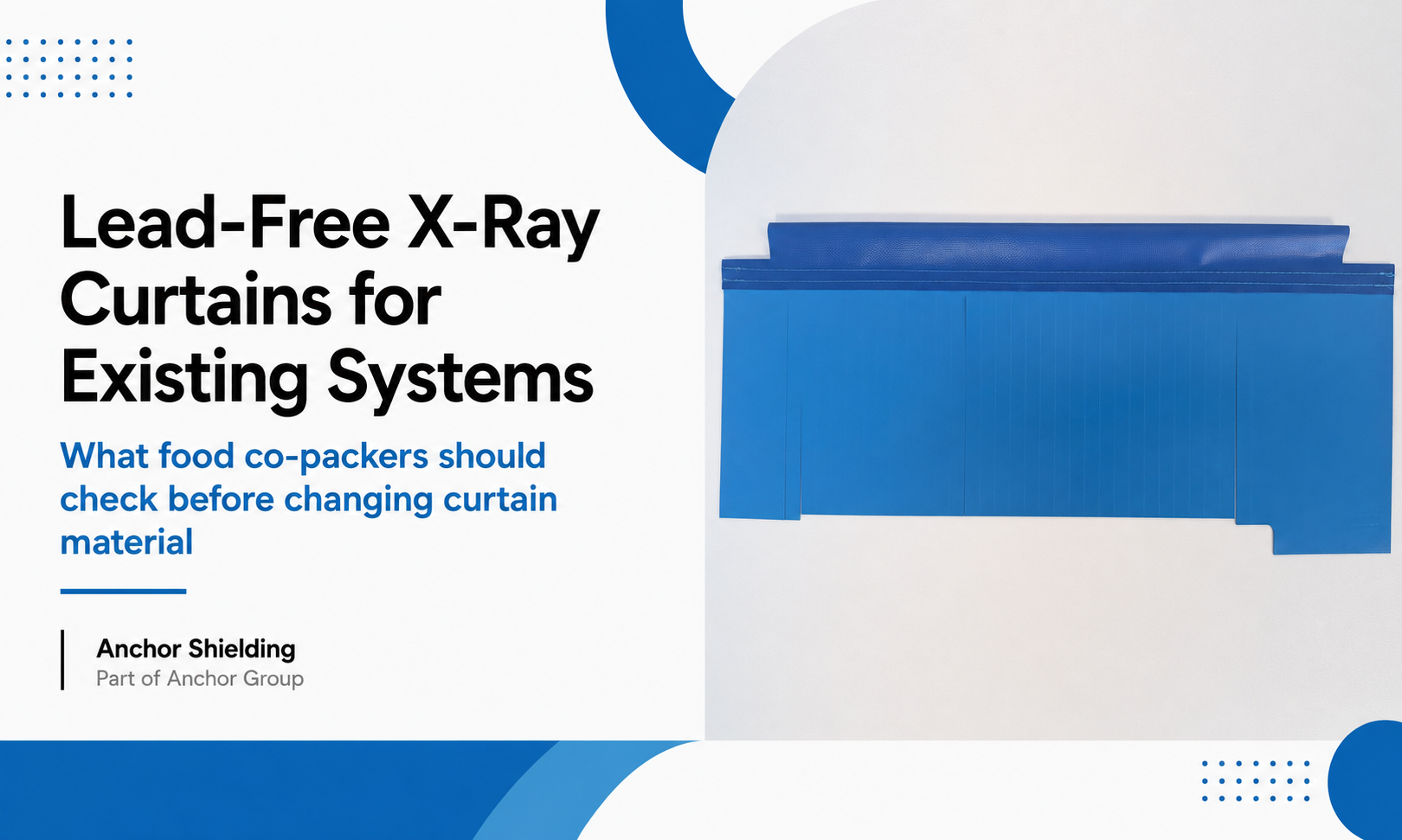
Luggage scanner curtains are not usually a single fixed sheet.
They are commonly supplied as flexible strips or curtain sets that overlap across the scanner opening. This allows objects to pass through while the curtain falls back into position after movement.
When specifying replacement curtains, it helps to consider:
- Overall curtain width and drop
- Strip width
- Overlap
- Number of strips
- Fixing method
- Entry or exit position
- Whether the curtain is being supplied as material, strips, panels or a finished replacement set
These details matter because a curtain that looks right as material may still be difficult to fit if the format is wrong.
Anchor Shielding can convert curtain material in-house to support replacement requirements, bespoke designs and project-specific formats.
Think about movement through the scanner
Luggage scanner curtains have to work in a live screening environment.
Bags and parcels are not all the same size, shape or weight. Some will pass through easily. Others may push, drag or bunch the curtain, especially if the material is too rigid, worn, heavy or not suited to the scanner opening.
This is why the practical behaviour of the curtain matters alongside the shielding requirement.
A suitable curtain should support the scanner’s required shielding performance while also allowing objects to move through the tunnel as intended.
For sites handling regular baggage, parcels or security screening loads, this practical side of the specification should not be left until installation.
Decide whether this is a direct replacement or a change
Some projects are straightforward replacement jobs. The existing curtain has worn, split or reached the point where it needs changing, and the aim is to replace it as closely as possible.
Other projects are different.
The buyer may be moving away from lead-based curtains. They may want a lead-free option for handling, waste or environmental reasons. They may also need a revised format because the current curtain is causing movement, fitting or durability issues.
Both types of enquiry are valid, but they need slightly different information.
For a direct replacement, the existing curtain dimensions and specification are usually the most important starting point.
For a change or upgrade, it is useful to understand what problem the current curtain is causing and what the replacement needs to improve.
Ask about samples where needed
Samples can be useful when buyers need to check the feel, flexibility or suitability of a lead-free curtain material before committing to a larger requirement.
This is particularly helpful when the project involves a new scanner design, a change from an existing curtain material, or a custom curtain format.
Anchor Shielding can provide samples where required and work with customers to understand the application before moving into supply or conversion.
What information should you send to specify luggage scanner curtains?
If you are reviewing lead-free safety curtains for a luggage scanner, the most useful information to send is:
- Scanner make and model
- Entry or exit curtain position
- Existing curtain photos
- Existing curtain dimensions
- Required lead equivalence or current curtain specification
- Tube voltage, if known
- Drawing or sample, if available
- Strip width, overlap and fixing method
- Quantity required
- Any issue with the current curtain, such as wear, stiffness, drag or poor fit
- Any documentation or project deadline requirements
You do not need to have all of this before starting a conversation.
If you only have the scanner model, photos or a current curtain to work from, that can still be enough to begin assessing the requirement.
Lead-free safety curtain support from Anchor Shielding
At Anchor Shielding, we supply lead-free radiation shielding curtain material for luggage scanners, security scanners and other X-ray inspection systems.
We can support replacement curtain requirements, bespoke designs, samples and in-house conversion based on the scanner, required shielding specification and final curtain format.
Whether you already have a full drawing or you are still working out what needs replacing, our team can help you identify the right starting point.
If you are specifying lead-free safety curtains for a luggage scanner, speak to Anchor Shielding to discuss your requirement.
If you are also reviewing supplier support, we have covered what buyers need from a lead-free safety curtain supplier in more detail.
For more on the wider role of lead-free radiation shielding for X-ray inspection applications, read our related guide.
FAQs
What are lead-free safety curtains for luggage scanners?
Lead-free safety curtains are flexible radiation shielding curtains used at the entry and exit points of X-ray luggage scanners. They help contain radiation while allowing bags, trays and parcels to pass through the scanner tunnel.
What information is needed to specify luggage scanner curtains?
Useful information includes the scanner make and model, existing curtain dimensions, required lead equivalence, tube voltage if known, strip width, overlap, fixing method, photos, drawings and quantity required.
Can luggage scanner curtains be made from a drawing?
Yes. Anchor Shielding can work from drawings, existing curtain requirements, photos or custom designs, depending on the project and the information available.
Do I need to know the exact shielding specification before enquiring?
No. If you know the required lead equivalence or existing curtain specification, it is helpful to share it. If not, Anchor Shielding can still help identify what information is needed next.
Can Anchor Shielding provide samples?
Yes. Samples can be provided where required, especially when buyers need to review material suitability before moving into a replacement or custom curtain requirement.