

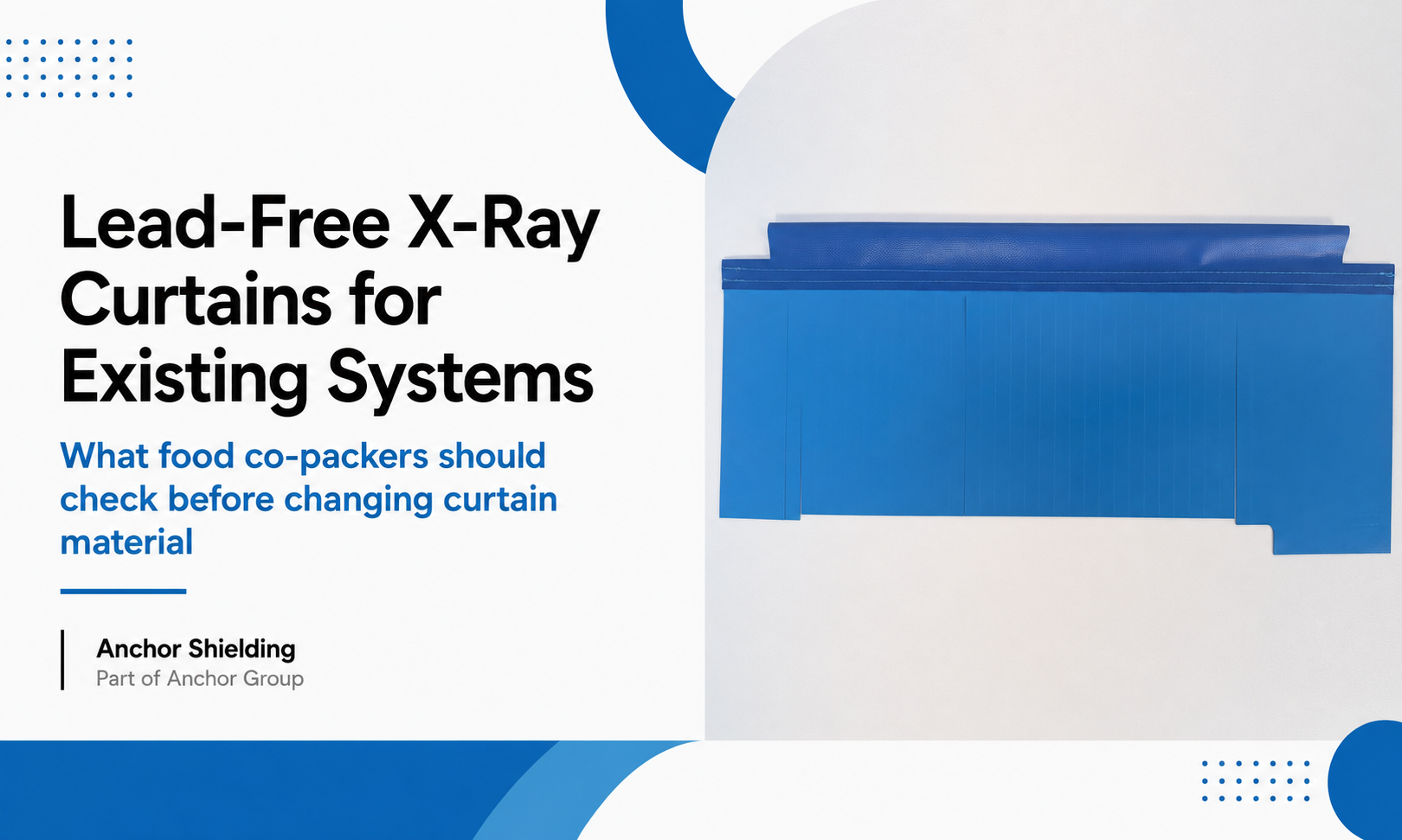
In many cases, lead-free replacement curtains can be produced for an existing food X-ray inspection system. However, compatibility should be established from the machine’s shielding specification, curtain arrangement and operating conditions. Matching the visible dimensions alone is not enough.
For co-packers running different products, customer contracts and scanner models, this provides a route to reviewing curtain material without automatically replacing otherwise serviceable inspection equipment.
Why existing inspection systems require a machine-specific review
An X-ray curtain forms part of the shielding arrangement around the tunnel opening. Its material, thickness, dimensions, strip overlap and position all contribute to the specified arrangement.
Two machines with similar tunnel openings may use different:
- tube voltages
- shielding requirements
- lead equivalence
- strip widths
- overlap patterns
- fixing-hole positions
- entry and exit arrangements
A curtain set should therefore be specified for the individual machine. Ordering one standard design across several inspection systems could result in a curtain that fits one machine but is unsuitable for another.
This is particularly relevant to co-packing sites, where equipment may have been purchased at different times or supplied by several manufacturers.
Does changing to lead-free curtains require a new X-ray inspection system?
Changing the curtain material does not necessarily mean replacing the complete inspection system.
Anchor Shielding can manufacture supashield™ lead-free replacement curtain sets, strips and panels to suit agreed details from existing food X-ray inspection equipment. This may involve working from an original drawing, the current curtain specification, accurate measurements, photographs or an existing sample.
The proposed curtain still needs to meet the shielding requirement of the machine. The required lead equivalence, tube voltage and curtain arrangement should be confirmed before manufacture.
Any material change or replacement should also follow the site’s own machine-safety, maintenance and validation procedures. Where necessary, the equipment manufacturer, service provider or responsible radiation-protection specialist should be involved.
What needs checking before lead-free curtains are specified?
A useful review covers four areas: shielding, physical fit, product movement and the operating environment.
1. Shielding specification
The required lead equivalence and operating tube voltage must be known. Lead-free describes the material composition; it does not remove the need to meet the machine’s required attenuation performance.
If the original specification is unavailable, it should be recovered through the relevant machine documentation, equipment manufacturer, service provider or other responsible technical source. It should not be estimated from curtain dimensions.
2. Curtain construction and fitting
The replacement set needs to match the agreed physical arrangement. Relevant details can include:
- curtain length and width
- material thickness
- number of strips
- width of each strip
- strip overlap
- number and position of curtain rows
- fixing-hole sizes and positions
- mounting method
- entry and exit configuration
A sample of the current curtain can be helpful where no usable drawing exists, although the shielding specification still needs to be confirmed separately.
3. Products passing through the machine
Co-packers may inspect pouches, trays, cartons, bags or wrapped products on the same line. Changes in pack height, weight or shape can alter how the product meets the curtain.
Curtains that drag excessively, lift unevenly or do not return cleanly after a pack has passed can interfere with production. Product formats and any known passage problems should therefore be discussed before the replacement arrangement is agreed.
This does not mean altering the shielding arrangement simply to reduce contact. It means considering product movement alongside the machine’s technical requirements.
4. Cleaning and production conditions
The material also has to suit the conditions around the inspection system. Cleaning methods, washdown routines, product residue, oils and operating temperature may all be relevant.
Food-safe material options are available, subject to assessment of the specific equipment, application, food-contact requirements and cleaning conditions. Any documentation needed for customer approval, site records or internal quality procedures should be identified before ordering.
What if the co-packer operates several different X-ray machines?
Treat each machine as a separate specification initially.
Once the curtain arrangement has been confirmed, the co-packer can create a simple record for future maintenance and purchasing. This could include:
- site and production line
- machine make and model
- machine or asset number
- required lead equivalence
- curtain-set drawing or reference
- strip dimensions and overlap
- fixing details
- approved material
- quantity fitted
- date replaced
- agreed supplier reference
This helps avoid relying on an unlabelled spare curtain or measurements taken during an urgent maintenance stop. It also gives procurement, engineering and quality teams a shared reference when another set is required.
Where two machines genuinely use the same approved arrangement, that can be recorded once the specifications have been compared. It should not be assumed from appearance alone.
Can curtains be assessed when the original drawing is missing?
Yes, an enquiry can begin without an original drawing.
Anchor Shielding can review photographs, dimensions, existing curtain samples and information about the current arrangement. We can then identify which details are available and which still need confirmation before a quotation or replacement set can be finalised.
Useful starting information includes:
- machine manufacturer and model
- tube voltage
- required lead equivalence
- tunnel-opening dimensions
- photographs of the entry and exit curtains
- photographs of the mounting arrangement
- curtain and strip measurements
- details of the products being inspected
- cleaning or washdown conditions
- required quantity
- any available drawings or manuals
Clear photographs should include both the complete curtain arrangement and close views of fixings, overlaps and any identification markings.
Planning lead-free curtain supply around co-packing work
Co-packing schedules can change quickly when contracts, pack formats or production volumes move between lines. Curtain specifications are easier to manage when they are recorded before a replacement becomes urgent.
A machine-by-machine review gives the site a confirmed basis for future orders. Replacement sets can then be identified by an agreed reference instead of being measured again each time.
It also allows co-packers to discuss lead-free curtain material with their customers, engineering teams and quality departments while the current equipment remains operational.
Ask Anchor Shielding to review your existing curtain arrangement
If you are considering lead-free X-ray curtains for an existing food inspection system, send Anchor Shielding the machine details, current curtain specification, photographs and drawings you have available.
Our team can assess the information, identify any missing details and quote for supashield™ curtain sets, strips or panels made to the agreed specification.
Send Anchor Shielding your curtain requirements and establish a documented replacement route for each inspection system on your site.