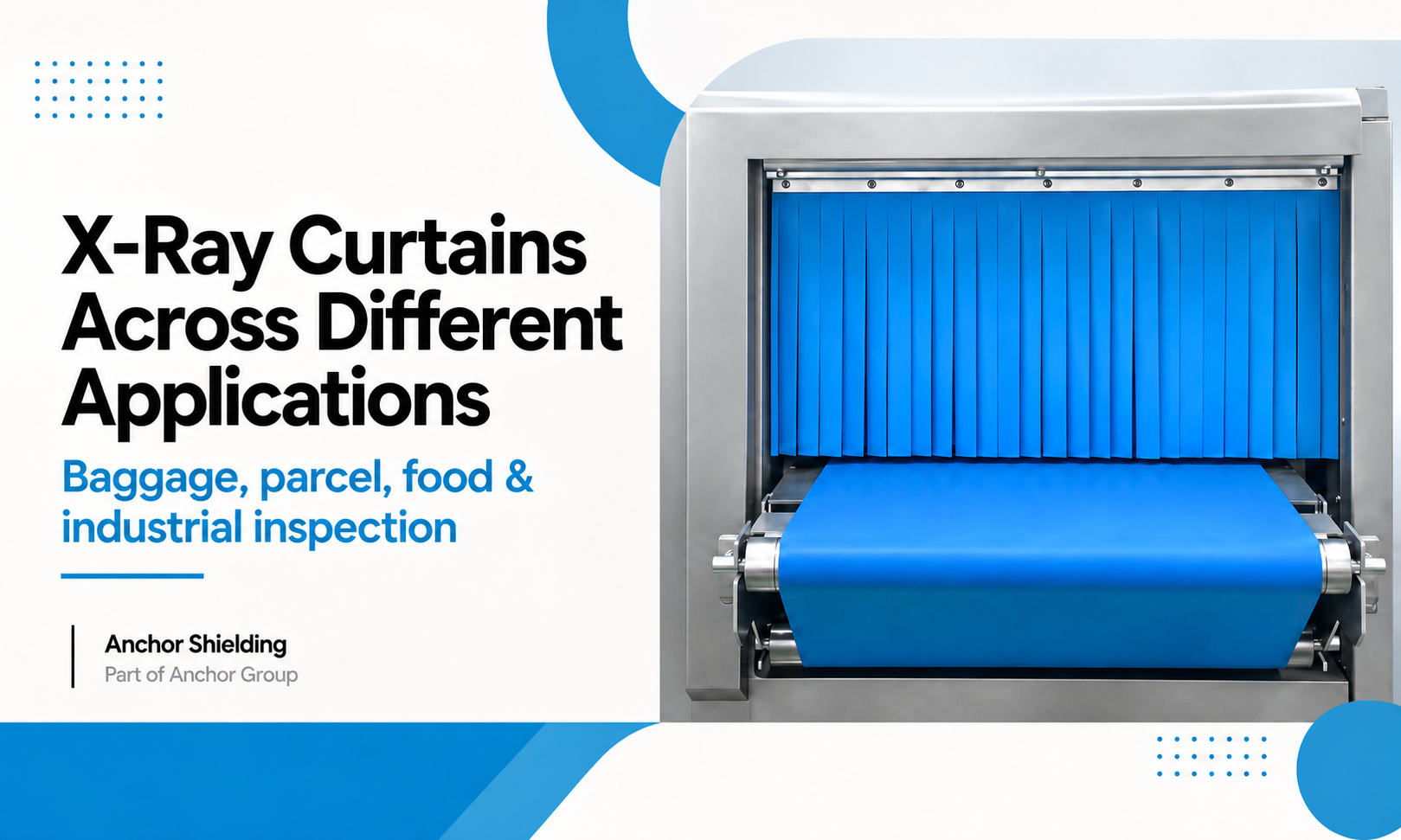


X-ray curtains are fitted at the openings of many inspection scanner tunnels. As products pass through, the curtains help limit radiation escaping through those openings and reduce potential exposure for people working nearby.
That safety purpose is central, but a curtain has to suit the scanner it is fitted to. Food inspection, baggage screening and parcel scanning systems can have different operating conditions and curtain arrangements. Three terms often come up when checking a curtain specification: lead equivalence, tube voltage, and narrow- or broad-beam testing. Here’s what they mean.
Lead equivalence: how a lead-free material is compared
Lead has long been used in radiation shielding, so it is a familiar reference for describing how materials attenuate X-rays. When we describe supashield™, our lead-free curtain material, in terms of lead equivalence, we are comparing its measured attenuation with that reference under stated test conditions.
Lead equivalence is usually written in millimetres of lead, or mm Pb. It describes a comparison; it does not mean that a lead-free material contains lead. Lead-based products are still used, and each customer’s requirements are different. The comparison is a way to describe shielding performance, not a judgement on which material is right for every application.
The test conditions matter. A lead-equivalence figure should be read alongside details such as the X-ray conditions and test method used. On its own, the number does not tell you whether a particular curtain is suitable for a particular scanner.
When we discuss replacement curtains, the required lead equivalence—or the existing approved curtain specification—is one of the details that helps us understand what the scanner requires.
Tube voltage: why it matters for X-ray curtains
Tube voltage is the electrical potential used to generate X-rays. It is measured in kilovolts (kV), often written as kVp.
Tube voltage is used to describe X-ray equipment in both medical and non-medical settings. Non-medical examples include food inspection, baggage screening and parcel scanning. The voltage varies with the equipment and the inspection task.
For a curtain specification, tube voltage matters because it affects the energy of the X-rays produced and their ability to pass through materials. The X-ray beam contains a range of energies, and filtration also affects its quality. A material’s measured shielding performance is therefore tied to the conditions under which it was tested.
That is why we ask for the scanner’s tube voltage when it is available: it helps us check whether the material information is relevant to the equipment. It is one part of the assessment, alongside the scanner’s required shielding specification and curtain arrangement. Tube voltage alone does not determine which curtain is suitable.
Narrow beam and broad beam: what the test measures
Narrow beam and broad beam describe two ways a laboratory can arrange an X-ray test. They do not describe different types of curtain or the shape of a scanner tunnel.
In a narrow-beam test, the setup limits scattered X-rays reaching the detector, so the measurement mainly reflects X-rays passing through the test material. In a broad-beam test, scattered X-rays can also contribute to the detector reading.
Why does that matter for a curtain? The test method tells you what a reported shielding figure represents. When comparing material information with a scanner’s specification, check the test method and conditions rather than comparing mm Pb figures in isolation. A test result by itself does not confirm that a finished curtain set, fitted in a particular arrangement, meets the scanner’s requirements.
What to check when specifying replacement X-ray curtains
Lead equivalence describes shielding performance against a lead reference. Tube voltage helps put that information in the context of the X-rays produced by the scanner. Beam geometry describes how the material was tested.
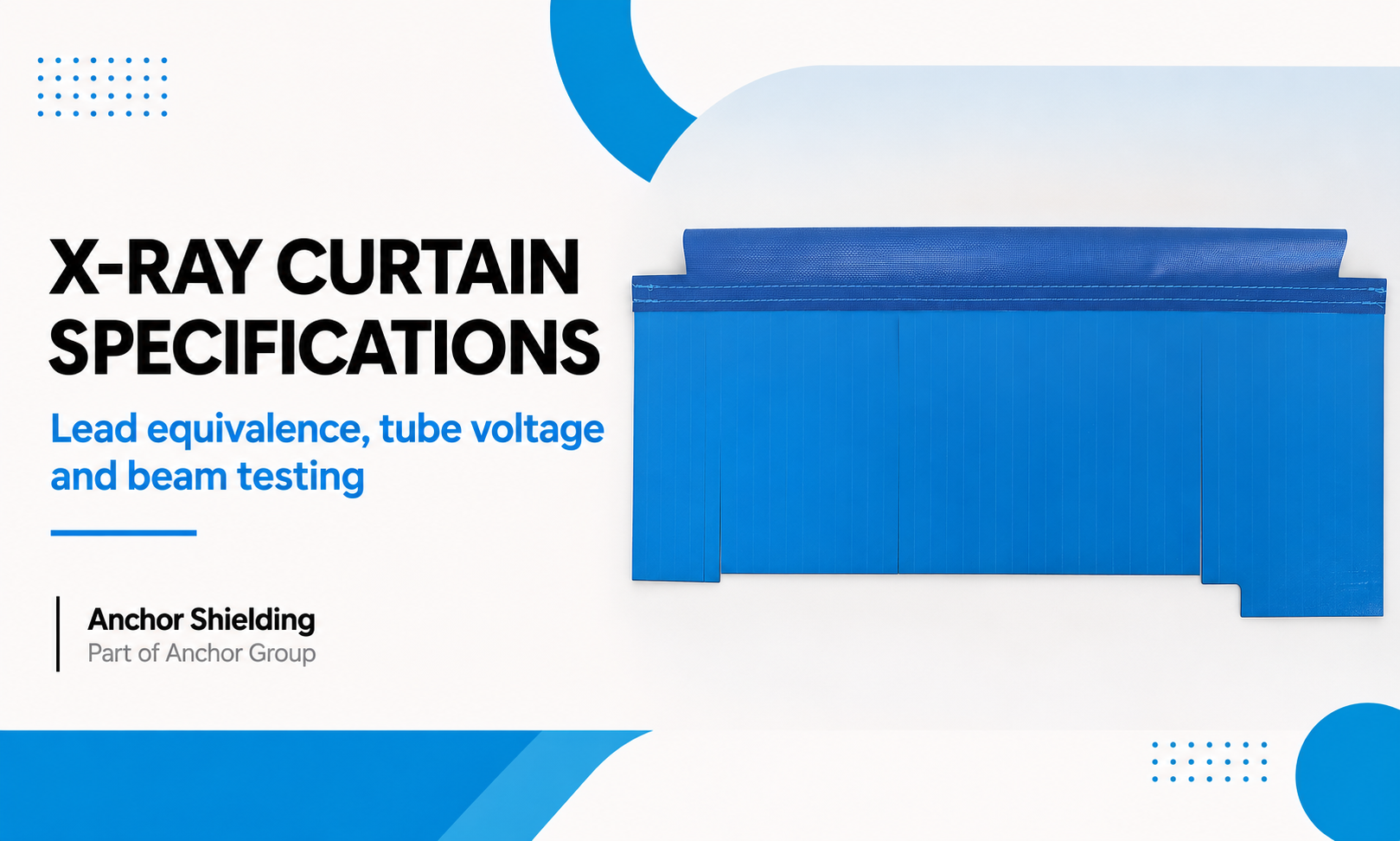
Together, these details help inform a curtain review, but the whole arrangement matters too. The scanner’s specification, curtain dimensions, strip layout and condition all play a part. A replacement should be assessed for the machine it is intended to fit.
If you are reviewing curtains for a food inspection, baggage or parcel scanner, send us the machine make and model, any existing curtain specification, the tube voltage if known, and any drawings, photographs or measurements you have. We can use the information available to discuss supashield™ lead-free curtain sets, strips or panels for your application.
Explore our food inspection X-ray curtains or baggage and security scanner curtains.